

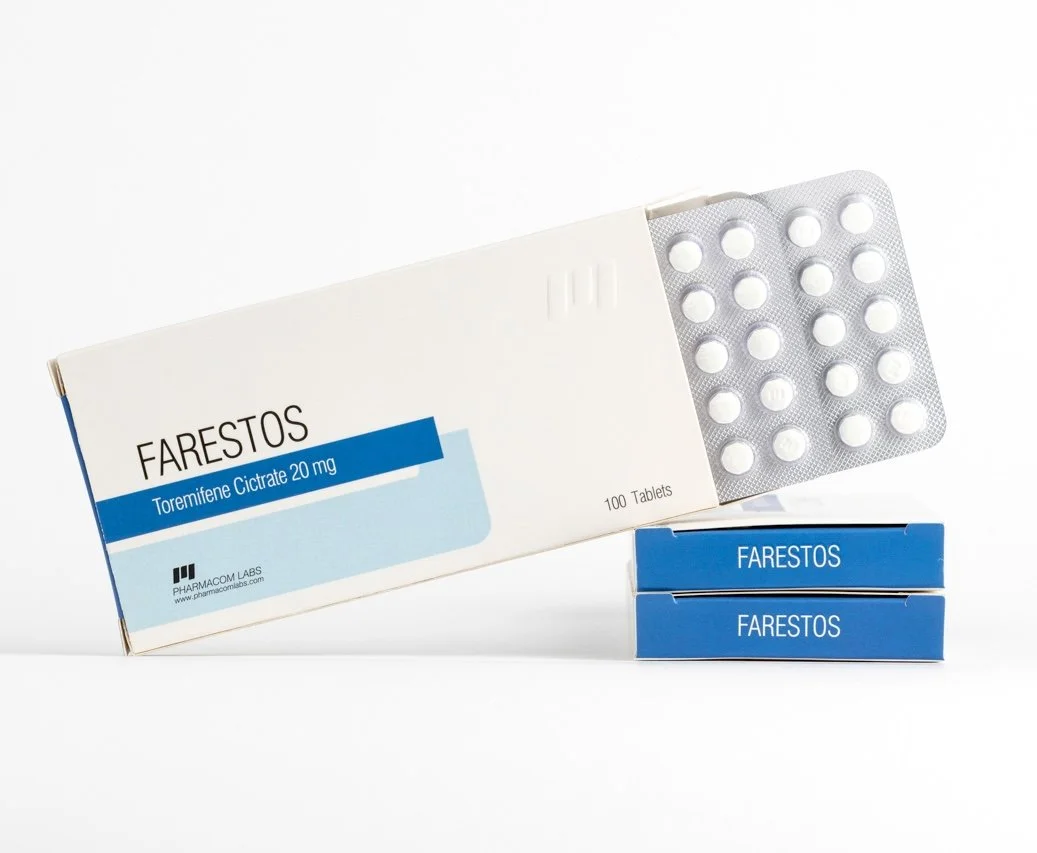
Toremifene Citrate 20 mg/tablet 100 tablets
Fareston (toremifene citrate) is a selective estrogen receptor modulator (SERM) derived from triphenylethylene. Toremifene was patented and approved in Europe in the mid-1990s for the treatment of ER+ metastatic breast cancer in postmenopausal women. Male bodybuilders use toremifene as a post-cycle therapy (PCT) medication and/or to block some of the effects of excess estradiol in the body resulting from the aromatization of various steroids. Toremifene inhibits the negative feedback of estrogen in the hypothalamus and pituitary gland, allowing the anterior pituitary to release the gonadotropic hormones follicle-stimulating hormone (FSH) and luteinizing hormone (LH). FSH stimulates spermatogenesis (in men), and LH stimulates the Leydig cells of the testes to secrete more testosterone. This is vital to minimize muscle mass loss after the cycle. Toremifene affects estrogen activity in several other tissues by competing with estradiol or binding to it with greater affinity at target receptors (hence the term SERM); it is mainly used to restore endogenous testosterone levels, as well as to prevent estrogen-induced gynecomastia.
It is important to note that toremifene does not reduce total plasma levels of circulating estradiol in the body; it only inhibits estrogen activity in certain tissues. This is the main difference between aromatase inhibitors (AIs) and SERMs. An AI binds to the aromatase enzyme, responsible for the conversion of androgens to estradiol (aromatization), and reduces total circulating estradiol levels in the body. Toremifene, being a SERM, is a true estrogen blocker that binds to the receptor site and remains inert (does not activate the receptors), resulting in the inability of estradiol to bind to these receptors, since they are already occupied by toremifene.
The chemical structure of toremifene is very similar to that of tamoxifen. However, toremifene is a newer generation drug that is much more desirable because it has fewer toxic side effects than tamoxifen (tamoxifen has already been determined to be carcinogenic). However, toremifene also has some negative properties. Firstly, and perhaps most importantly, is its effect on levels of Sex Hormone-Binding Globulin (SHBG) in the body; clinical research has shown that while toremifene can stimulate the body's natural endogenous production of testosterone, it raises SHBG levels in the blood.
WARNING: Toremifene increases levels of sex hormone-binding globulin (SHBG) in the blood; therefore, it may decrease the effectiveness of a cycle when taken during a cycle as a medication to combat the symptoms of gynecomastia.
Furthermore, it has been determined that toremifene is not as potent as an equivalent dose of tamoxifen in restoring the HPTA axis and endogenous testosterone production in men. Studies have shown that toremifene, when administered at doses of 60 mg daily, increased testosterone levels in tested individuals by a significant increase of 42%, while in the same study, a standard dose of 20 mg daily of tamoxifen increased testosterone levels by 71%.
Therefore, the dosage of toremifene, for a more effective increase in testosterone production, should be in the range of up to 120 mg per day. This dose can be maintained during the first week of PCT (Post Cycle Therapy), 100 mg/day during the second week, and then 60 mg/day during the remaining 3 to 4 weeks of PCT. Obviously, the exact dosages should be determined individually based on blood test results.
RECOMMENDATION: The correct time to start post-cycle therapy (PCT) depends entirely on the type and half-life of the steroids you used. Toremifene, when taken while blood androgen levels are still high, will be a waste. It is crucial to wait for androgen levels to decrease before starting PCT. However, if started too late, there is a risk of losing hard-earned, quality muscle mass.
Chemical name 2-{4-[(1Z)-4-chloro-1,2-diphenyl-but-1-en-1-yl]phenoxy}-N,N-dimethylethaneamine
Formula C26H28ClNO
Anabolic activity index is not a steroid.
Androgenic activity index is not a steroid.
Fareston (toremifene citrate) is a selective estrogen receptor modulator (SERM) derived from triphenylethylene. Toremifene was patented and approved in Europe in the mid-1990s for the treatment of ER+ metastatic breast cancer in postmenopausal women. Male bodybuilders use toremifene as a post-cycle therapy (PCT) medication and/or to block some of the effects of excess estradiol in the body resulting from the aromatization of various steroids. Toremifene inhibits the negative feedback of estrogen in the hypothalamus and pituitary gland, allowing the anterior pituitary to release the gonadotropic hormones follicle-stimulating hormone (FSH) and luteinizing hormone (LH). FSH stimulates spermatogenesis (in men), and LH stimulates the Leydig cells of the testes to secrete more testosterone. This is vital to minimize muscle mass loss after the cycle. Toremifene affects estrogen activity in several other tissues by competing with estradiol or binding to it with greater affinity at target receptors (hence the term SERM); it is mainly used to restore endogenous testosterone levels, as well as to prevent estrogen-induced gynecomastia.
It is important to note that toremifene does not reduce total plasma levels of circulating estradiol in the body; it only inhibits estrogen activity in certain tissues. This is the main difference between aromatase inhibitors (AIs) and SERMs. An AI binds to the aromatase enzyme, responsible for the conversion of androgens to estradiol (aromatization), and reduces total circulating estradiol levels in the body. Toremifene, being a SERM, is a true estrogen blocker that binds to the receptor site and remains inert (does not activate the receptors), resulting in the inability of estradiol to bind to these receptors, since they are already occupied by toremifene.
The chemical structure of toremifene is very similar to that of tamoxifen. However, toremifene is a newer generation drug that is much more desirable because it has fewer toxic side effects than tamoxifen (tamoxifen has already been determined to be carcinogenic). However, toremifene also has some negative properties. Firstly, and perhaps most importantly, is its effect on levels of Sex Hormone-Binding Globulin (SHBG) in the body; clinical research has shown that while toremifene can stimulate the body's natural endogenous production of testosterone, it raises SHBG levels in the blood.
WARNING: Toremifene increases levels of sex hormone-binding globulin (SHBG) in the blood; therefore, it may decrease the effectiveness of a cycle when taken during a cycle as a medication to combat the symptoms of gynecomastia.
Furthermore, it has been determined that toremifene is not as potent as an equivalent dose of tamoxifen in restoring the HPTA axis and endogenous testosterone production in men. Studies have shown that toremifene, when administered at doses of 60 mg daily, increased testosterone levels in tested individuals by a significant increase of 42%, while in the same study, a standard dose of 20 mg daily of tamoxifen increased testosterone levels by 71%.
Therefore, the dosage of toremifene, for a more effective increase in testosterone production, should be in the range of up to 120 mg per day. This dose can be maintained during the first week of PCT (Post Cycle Therapy), 100 mg/day during the second week, and then 60 mg/day during the remaining 3 to 4 weeks of PCT. Obviously, the exact dosages should be determined individually based on blood test results.
RECOMMENDATION: The correct time to start post-cycle therapy (PCT) depends entirely on the type and half-life of the steroids you used. Toremifene, when taken while blood androgen levels are still high, will be a waste. It is crucial to wait for androgen levels to decrease before starting PCT. However, if started too late, there is a risk of losing hard-earned, quality muscle mass.
Chemical name 2-{4-[(1Z)-4-chloro-1,2-diphenyl-but-1-en-1-yl]phenoxy}-N,N-dimethylethaneamine
Formula C26H28ClNO
Anabolic activity index is not a steroid.
Androgenic activity index is not a steroid.