

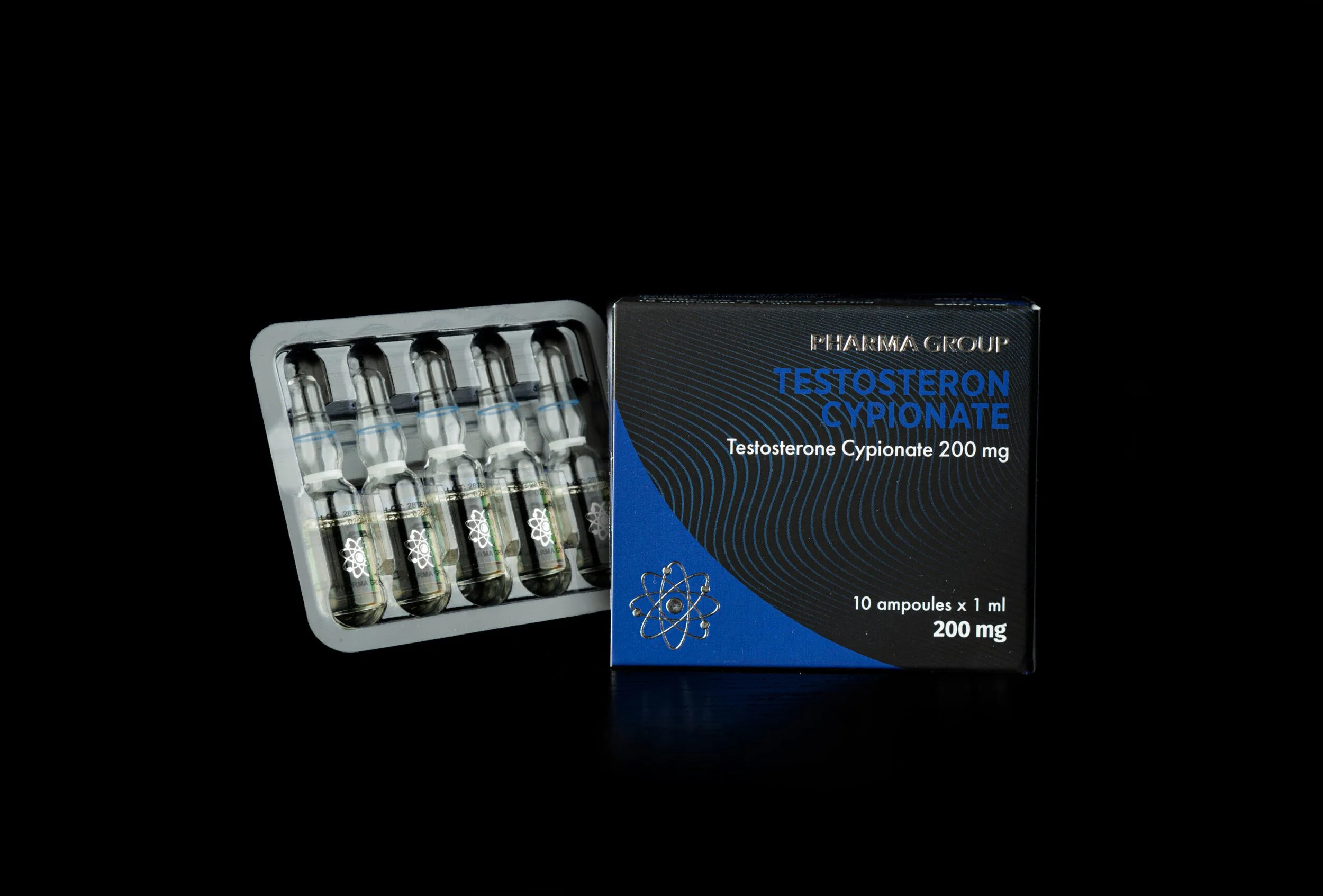
Testosterone Cypionate PharmaGroup
Synthetic testosterone was synthesized in 1935 by the German biochemist Adolf Butenandt and the Swiss chemist Leopold Ruzicka, who received the Nobel Prize for their work. Testosterone is the primary male sex hormone, directly affecting the testicles and prostate development, and has a significant impact on muscle tissue building, bone density, and strength. Furthermore, testosterone is largely responsible for dozens of functions in the human body: general health, well-being, increased libido, energy, immunity, prevention of osteoporosis (loss of bone density), and possible protection against heart disease. Maintaining higher testosterone levels in older men has been shown to improve many parameters believed to reduce the risk of cardiovascular disease, such as increased lean body mass, decreased visceral fat mass, decreased total cholesterol, and glycemic control. It determines not only gender differences but, for example, regulates the population of thromboxane A2 receptors in megakaryocytes and platelets, and therefore platelet aggregation in humans. Testosterone is responsible for behavior, mood, and romantic relationships, and according to reports, it can even impact career choices. Studies indicate that attention, memory, and spatial ability are important cognitive functions affected by testosterone in humans. Preliminary evidence suggests that low testosterone levels may be a risk factor for cognitive decline and possibly Alzheimer's-type dementia, a key argument in life-extending medicine for the use of testosterone in anti-aging therapies. Testosterone is highly valued by athletes for its ability to promote significant increases in muscle mass and strength. As a natural hormone, it remains the most popular anabolic steroid and is commonly used as the basis of all cycles and stacks. For bodybuilding use, testosterone is almost always used as an injectable ester or suspension due to its low oral bioavailability and the impracticality of transdermal or sublingual administration at high doses. All forms of testosterone are broadly the same: active agent testosterone + attached ester, which determines the release time and the active lifespan of the compound. In summary: long esters release the active agent into the bloodstream slowly, but provide a stable hormone level for a long time (depending on the ester), without creating spikes. It should be noted that in men, approximately 5% of testosterone undergoes 5α reduction to form the more potent androgen, dihydrotestosterone (DHT), also known as androstanolone. On the other hand, approximately 0.3% of testosterone is converted to estradiol (the main female sex hormone) by aromatase, an enzyme expressed in the brain, liver, and adipose tissue. Therefore,Remember to take precautions to avoid the respective side effects. Therefore, we recommend having blood tests done and taking aromatase inhibitors during the cycle (if necessary, anastrozole is preferable) and SERMs (clomiphene, toremifene) during post-cycle therapy (PCT).
Synthetic testosterone was synthesized in 1935 by the German biochemist Adolf Butenandt and the Swiss chemist Leopold Ruzicka, who received the Nobel Prize for their work. Testosterone is the primary male sex hormone, directly affecting the testicles and prostate development, and has a significant impact on muscle tissue building, bone density, and strength. Furthermore, testosterone is largely responsible for dozens of functions in the human body: general health, well-being, increased libido, energy, immunity, prevention of osteoporosis (loss of bone density), and possible protection against heart disease. Maintaining higher testosterone levels in older men has been shown to improve many parameters believed to reduce the risk of cardiovascular disease, such as increased lean body mass, decreased visceral fat mass, decreased total cholesterol, and glycemic control. It determines not only gender differences but, for example, regulates the population of thromboxane A2 receptors in megakaryocytes and platelets, and therefore platelet aggregation in humans. Testosterone is responsible for behavior, mood, and romantic relationships, and according to reports, it can even impact career choices. Studies indicate that attention, memory, and spatial ability are important cognitive functions affected by testosterone in humans. Preliminary evidence suggests that low testosterone levels may be a risk factor for cognitive decline and possibly Alzheimer's-type dementia, a key argument in life-extending medicine for the use of testosterone in anti-aging therapies. Testosterone is highly valued by athletes for its ability to promote significant increases in muscle mass and strength. As a natural hormone, it remains the most popular anabolic steroid and is commonly used as the basis of all cycles and stacks. For bodybuilding use, testosterone is almost always used as an injectable ester or suspension due to its low oral bioavailability and the impracticality of transdermal or sublingual administration at high doses. All forms of testosterone are broadly the same: active agent testosterone + attached ester, which determines the release time and the active lifespan of the compound. In summary: long esters release the active agent into the bloodstream slowly, but provide a stable hormone level for a long time (depending on the ester), without creating spikes. It should be noted that in men, approximately 5% of testosterone undergoes 5α reduction to form the more potent androgen, dihydrotestosterone (DHT), also known as androstanolone. On the other hand, approximately 0.3% of testosterone is converted to estradiol (the main female sex hormone) by aromatase, an enzyme expressed in the brain, liver, and adipose tissue. Therefore,Remember to take precautions to avoid the respective side effects. Therefore, we recommend having blood tests done and taking aromatase inhibitors during the cycle (if necessary, anastrozole is preferable) and SERMs (clomiphene, toremifene) during post-cycle therapy (PCT).