

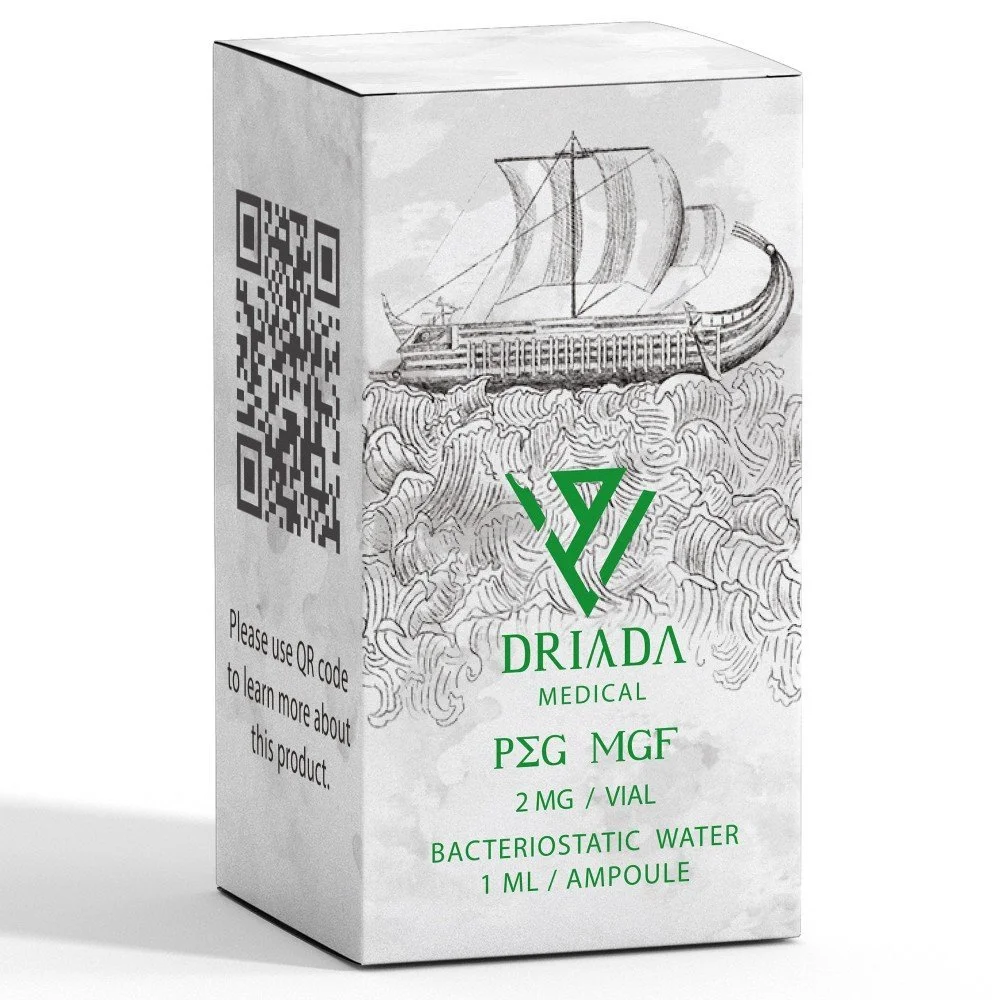
What is PEG-MGF?
PEG-MGF is Pegylated Mechanogrowth Factor, a long-acting variant of MGF, with a significantly extended biological elimination half-life: The main disadvantage of MGF (IGF-1Ec) is an extremely short half-life, estimated at only a few minutes (only 5-7 minutes). Pegylation is the process of attaching one or more strands to a protein or peptide using a substance called a polyethylene glycol (PEG) molecule.
Polyethylene glycol is an inert, non-toxic, and very suitable protection for the amine group due to its structure and flexibility. Since the body does not react with PEG, it helps provide a protective barrier around the desired protein or peptide. This results in an increased half-life, and the peptide will be able to survive in the body and act for much longer. Pegylation is frequently used to protect substances that are often exposed to enzymatic attack.
Possible benefits of MGF scientifically investigated.
Strong anabolic effect and ability to repair and rebuild muscles.
Ability to induce muscle hyperplasia (growth of new muscle cells)
Neuroprotective effect (protects the nervous system and brain functions)
It mediates the survival of myocardial cells and myocardial repair.
Important functions in tissue growth and wound healing.
Positive role in bone wound healing
What is PEG-MGF?
PEG-MGF is Pegylated Mechanogrowth Factor, a long-acting variant of MGF, with a significantly extended biological elimination half-life: The main disadvantage of MGF (IGF-1Ec) is an extremely short half-life, estimated at only a few minutes (only 5-7 minutes). Pegylation is the process of attaching one or more strands to a protein or peptide using a substance called a polyethylene glycol (PEG) molecule.
Polyethylene glycol is an inert, non-toxic, and very suitable protection for the amine group due to its structure and flexibility. Since the body does not react with PEG, it helps provide a protective barrier around the desired protein or peptide. This results in an increased half-life, and the peptide will be able to survive in the body and act for much longer. Pegylation is frequently used to protect substances that are often exposed to enzymatic attack.
Possible benefits of MGF scientifically investigated.
Strong anabolic effect and ability to repair and rebuild muscles.
Ability to induce muscle hyperplasia (growth of new muscle cells)
Neuroprotective effect (protects the nervous system and brain functions)
It mediates the survival of myocardial cells and myocardial repair.
Important functions in tissue growth and wound healing.
Positive role in bone wound healing