

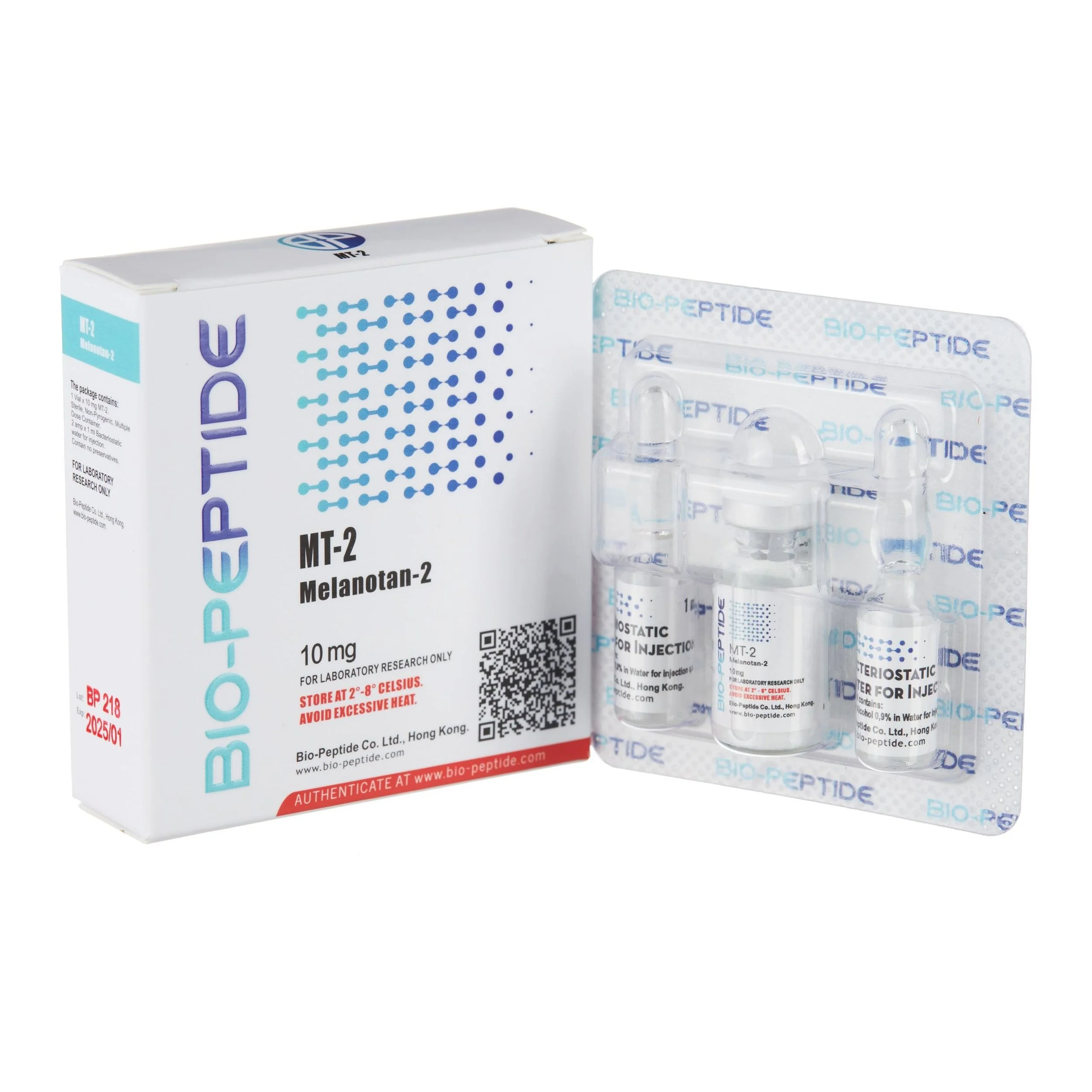
MT-2 (or Melanotan II) is another synthetic peptide derived from natural hormones and a cyclic lactam analog of the protein hormone melanocortin, an alpha-melanocyte-stimulating hormone; its molecular weight/mass is 1024.2 with the molecular formula C50H69N15O9. This analog possesses typical protein characteristics. Melanotan II was purposefully created in 1991 by American researchers in Arizona under the leadership of Hruby/Hedley, while they were searching for a more stable and potent modification of the primitive α-MSH. After that, several clinical studies were conducted in different countries to identify the efficacy of the newly developed peptide. Like its predecessor, Melanotan I, MT-2 plays a role in stimulating melanogenesis and therefore provides a protective mechanism against UV rays, since under its action melanocytes are able to increase the production and secretion of the hormone melanin, which is also a type of peptide. However, scientists have also noticed another characteristic of this research compound: certain aphrodisiac effects. It also has a slight positive effect on fat mobilization. For research purposes only.
MT-2 (or Melanotan II) is another synthetic peptide derived from natural hormones and a cyclic lactam analog of the protein hormone melanocortin, an alpha-melanocyte-stimulating hormone; its molecular weight/mass is 1024.2 with the molecular formula C50H69N15O9. This analog possesses typical protein characteristics. Melanotan II was purposefully created in 1991 by American researchers in Arizona under the leadership of Hruby/Hedley, while they were searching for a more stable and potent modification of the primitive α-MSH. After that, several clinical studies were conducted in different countries to identify the efficacy of the newly developed peptide. Like its predecessor, Melanotan I, MT-2 plays a role in stimulating melanogenesis and therefore provides a protective mechanism against UV rays, since under its action melanocytes are able to increase the production and secretion of the hormone melanin, which is also a type of peptide. However, scientists have also noticed another characteristic of this research compound: certain aphrodisiac effects. It also has a slight positive effect on fat mobilization. For research purposes only.