


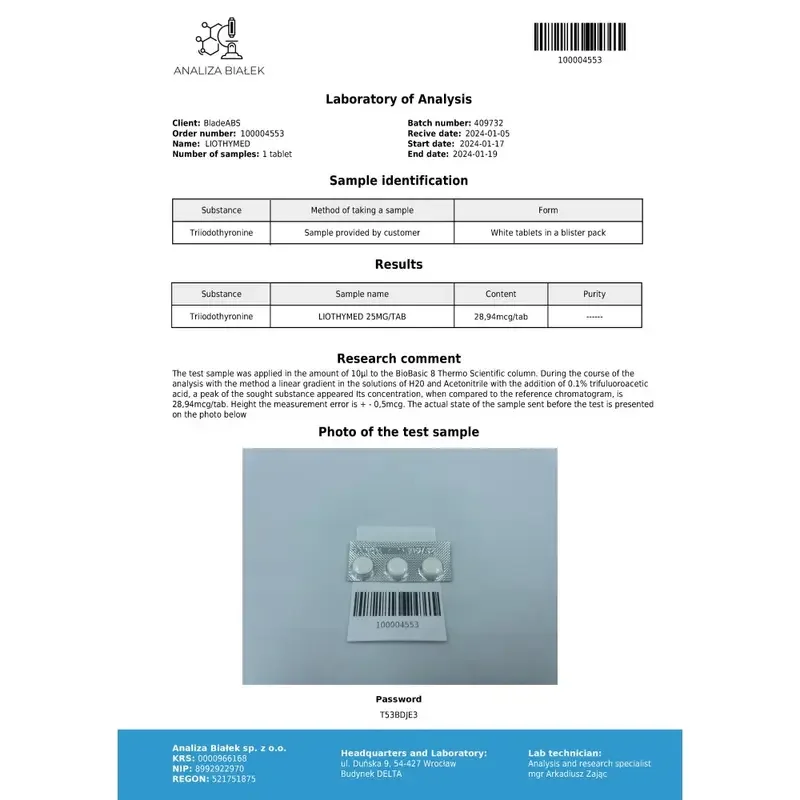
Liothymed 25 mcg (T3 – Triiodothyronine) 100 Tabs
Active ingredient: Triiodothyronine
Type: Thyroid
Form: Oral (tablets)
Description:
Thyroid hormones are the only known biologically active substances that contain iodine. They have two important functions: in a growing body they are necessary for normal development, especially of the central nervous system, and in adults they are responsible for regulating metabolism, acting on almost all organs and tissues, regulating energy expenditure, its rate and volume.
To ensure these functions, the thyroid gland contains large reserves of thyroid hormones. The metabolism of thyroid hormones occurs mainly in the liver, but is partially carried out in target tissues, for example, in the brain. The level of thyroid hormones in the plasma is regulated very precisely by the anterior pituitary gland using TSH with the participation of negative feedback mechanisms. TSH serves as a signal for the production of thyroid hormones, the main one being T4, which can be converted into T3 mainly in the tissues.
Thyroid hormones act primarily through intracellular receptors that affect the expression of certain genes.
Mechanism of action
: According to modern concepts, T3 binds to intracellular receptors, leading to a change in their affinity for T3-sensitive regulatory elements that regulate the expression of certain genes. Thus, T3 affects gene expression and, therefore, protein synthesis. Normally, a free receptor binds to a regulatory element and suppresses the expression of the corresponding gene, although in some cases it may activate it. By binding to the hormone, the receptor increases expression (or, conversely, suppresses it). T4 binds to the same receptors, but its affinity for them is much lower than that of T3. However, despite T4's ability to bind to receptors, the effect of T4 on gene expression has not been demonstrated. So, in a way, T4 can be considered a prohormone, since its effect on gene expression is due to conversion to T3.
There are effective treatments for most thyroid diseases. The treatment method for hypothyroidism is obvious – replacement therapy is prescribed.
For medical purposes, T4 is prescribed in most cases. Both medications are used in sports, but for slightly different purposes.
Liotimed activates the production of beta-2 adrenergic receptors in adipose tissue. In adipose tissue lipolysis, the main role is played by the enzyme HSL (hormone-sensitive lipase). Hormone-sensitive lipase controls the rate of lipolysis. To activate HSL, the body needs epinephrine and nopinephrine (catecholamines). Epinephrine and nopinephrine bind to beta-2 receptors, and therefore, when liothymed stimulates beta receptors, there is an appropriate increase in the ability of catecholamines to activate HSL, responding to stimulated lipolysis.
Purposes of use:
Triiodothyronine (T3) or liothyronine is essentially a thyroid hormone that can help people with fat loss and have an impact during anabolic processes. It also helps in the production of GH hormone in a more noticeable way and increases anabolism in the body, in addition to its effects on fat loss.
T3 – often used for weight loss instead of thyroxine, are nearly identical in their mechanism of action. T3, unlike T4, more actively affects the biochemical pathways of protein catabolism. When both medications are administered to achieve the same fat loss, T3 burns significantly more muscle than T4. Note that T3 is formed from the hormone T4, or from the hormone thyroxine as the more active form of T4.
T3 stimulates skeletal muscle growth by increasing the number and diameter of muscle fibers and plays a role in the transition of neonatal to adult myosin isoforms.
Liothymed for Sports Purposes:
Athletes stimulate their metabolic process with the use of liothymed, which causes a faster conversion of carbohydrates, proteins, and fats. Athletes are interested in stimulating fat burning. Liothymed can be administered in combination with different types of anabolic steroids. By combining the drug with anabolic steroids, you can obtain a stronger anabolic effect. Therefore, doing everything right, you will have more pronounced muscles. If your goal is to achieve the perfect balance between a normal physique and large, strong muscles, Liothymed is ideal and will handle this very effectively.
How to use:
Basically, the dosage starts with 25 mcg per day and increases by 25 mcg per day every 5-6 days. The maximum is 100 mcg per day. Distribute a few tablets throughout the day. The maximum cycle lasts seven weeks. At least six weeks should pass between cycles. Additionally, it will help the thyroid gland return to normal function. It is commonly combined with clenbuterol to make both even more effective at burning fat.
Average dose: 25 to 100 mcg per day.
Effective dosage: pyramidal method (25-50-75-100-75-50-25).
Proven cycle: 5-6 weeks.
Effects:
Regulates your metabolism,
burns fat,
increases anabolic processes and muscle growth.
Warnings
: Please note that you will lose MUCH more muscle on T3 without any anabolic assistance than you would with it.
Liothyronine can cause increased blood sugar. Therefore, high blood sugar levels may appear, glucose tolerance may be altered, and diabetes may worsen. People with diabetes should closely monitor their blood sugar levels and inform their doctor of any abnormalities.
Heart disease: Starting liothyronine may cause the heart to work harder than before. For this reason, people suffering from angina or other heart conditions should ask their pharmacist how this preparation may affect their medical condition, how their medical condition may influence the dosage and effectiveness of this preparation, and whether any special checks are needed. Pregnancy:
This preparation is safe for use during pregnancy.
Breastfeeding: Liothymed passes into breast milk in small amounts. It is essential to continue using the thyroid hormone even if you are breastfeeding. Inform your pharmacist if you are breastfeeding or intend to breastfeed while taking liothymed.
Elderly people: The elderly may be more sensitive to the effects of liothymed and should be aware of undesirable effects, especially those related to the heart.
Side effects:
Chest pain, discomfort or tightness;
difficulty swallowing;
extreme fatigue;
fainting
; rapid, slow, irregular, accelerated or racing heartbeat or pulse;
heat intolerance
; nausea
; sweating
; tremors.
Profile
Half-life: 6-24 hours
Frequency of intake: 1-2 times per day
Contraindications:
Contraindicated in patients with untreated subclinical overt thyrotoxicosis (suppressed serum TSH levels with normal T3 and T4 levels) of any etiology and in patients with acute myocardial infarction.
Storage instructions:
Keep out of reach of children.
Store in a cool, dry place away from direct sunlight.
Store at room temperature.
Do not use after the expiration date.
Active ingredient: Triiodothyronine
Type: Thyroid
Form: Oral (tablets)
Description:
Thyroid hormones are the only known biologically active substances that contain iodine. They have two important functions: in a growing body they are necessary for normal development, especially of the central nervous system, and in adults they are responsible for regulating metabolism, acting on almost all organs and tissues, regulating energy expenditure, its rate and volume.
To ensure these functions, the thyroid gland contains large reserves of thyroid hormones. The metabolism of thyroid hormones occurs mainly in the liver, but is partially carried out in target tissues, for example, in the brain. The level of thyroid hormones in the plasma is regulated very precisely by the anterior pituitary gland using TSH with the participation of negative feedback mechanisms. TSH serves as a signal for the production of thyroid hormones, the main one being T4, which can be converted into T3 mainly in the tissues.
Thyroid hormones act primarily through intracellular receptors that affect the expression of certain genes.
Mechanism of action
: According to modern concepts, T3 binds to intracellular receptors, leading to a change in their affinity for T3-sensitive regulatory elements that regulate the expression of certain genes. Thus, T3 affects gene expression and, therefore, protein synthesis. Normally, a free receptor binds to a regulatory element and suppresses the expression of the corresponding gene, although in some cases it may activate it. By binding to the hormone, the receptor increases expression (or, conversely, suppresses it). T4 binds to the same receptors, but its affinity for them is much lower than that of T3. However, despite T4's ability to bind to receptors, the effect of T4 on gene expression has not been demonstrated. So, in a way, T4 can be considered a prohormone, since its effect on gene expression is due to conversion to T3.
There are effective treatments for most thyroid diseases. The treatment method for hypothyroidism is obvious – replacement therapy is prescribed.
For medical purposes, T4 is prescribed in most cases. Both medications are used in sports, but for slightly different purposes.
Liotimed activates the production of beta-2 adrenergic receptors in adipose tissue. In adipose tissue lipolysis, the main role is played by the enzyme HSL (hormone-sensitive lipase). Hormone-sensitive lipase controls the rate of lipolysis. To activate HSL, the body needs epinephrine and nopinephrine (catecholamines). Epinephrine and nopinephrine bind to beta-2 receptors, and therefore, when liothymed stimulates beta receptors, there is an appropriate increase in the ability of catecholamines to activate HSL, responding to stimulated lipolysis.
Purposes of use:
Triiodothyronine (T3) or liothyronine is essentially a thyroid hormone that can help people with fat loss and have an impact during anabolic processes. It also helps in the production of GH hormone in a more noticeable way and increases anabolism in the body, in addition to its effects on fat loss.
T3 – often used for weight loss instead of thyroxine, are nearly identical in their mechanism of action. T3, unlike T4, more actively affects the biochemical pathways of protein catabolism. When both medications are administered to achieve the same fat loss, T3 burns significantly more muscle than T4. Note that T3 is formed from the hormone T4, or from the hormone thyroxine as the more active form of T4.
T3 stimulates skeletal muscle growth by increasing the number and diameter of muscle fibers and plays a role in the transition of neonatal to adult myosin isoforms.
Liothymed for Sports Purposes:
Athletes stimulate their metabolic process with the use of liothymed, which causes a faster conversion of carbohydrates, proteins, and fats. Athletes are interested in stimulating fat burning. Liothymed can be administered in combination with different types of anabolic steroids. By combining the drug with anabolic steroids, you can obtain a stronger anabolic effect. Therefore, doing everything right, you will have more pronounced muscles. If your goal is to achieve the perfect balance between a normal physique and large, strong muscles, Liothymed is ideal and will handle this very effectively.
How to use:
Basically, the dosage starts with 25 mcg per day and increases by 25 mcg per day every 5-6 days. The maximum is 100 mcg per day. Distribute a few tablets throughout the day. The maximum cycle lasts seven weeks. At least six weeks should pass between cycles. Additionally, it will help the thyroid gland return to normal function. It is commonly combined with clenbuterol to make both even more effective at burning fat.
Average dose: 25 to 100 mcg per day.
Effective dosage: pyramidal method (25-50-75-100-75-50-25).
Proven cycle: 5-6 weeks.
Effects:
Regulates your metabolism,
burns fat,
increases anabolic processes and muscle growth.
Warnings
: Please note that you will lose MUCH more muscle on T3 without any anabolic assistance than you would with it.
Liothyronine can cause increased blood sugar. Therefore, high blood sugar levels may appear, glucose tolerance may be altered, and diabetes may worsen. People with diabetes should closely monitor their blood sugar levels and inform their doctor of any abnormalities.
Heart disease: Starting liothyronine may cause the heart to work harder than before. For this reason, people suffering from angina or other heart conditions should ask their pharmacist how this preparation may affect their medical condition, how their medical condition may influence the dosage and effectiveness of this preparation, and whether any special checks are needed. Pregnancy:
This preparation is safe for use during pregnancy.
Breastfeeding: Liothymed passes into breast milk in small amounts. It is essential to continue using the thyroid hormone even if you are breastfeeding. Inform your pharmacist if you are breastfeeding or intend to breastfeed while taking liothymed.
Elderly people: The elderly may be more sensitive to the effects of liothymed and should be aware of undesirable effects, especially those related to the heart.
Side effects:
Chest pain, discomfort or tightness;
difficulty swallowing;
extreme fatigue;
fainting
; rapid, slow, irregular, accelerated or racing heartbeat or pulse;
heat intolerance
; nausea
; sweating
; tremors.
Profile
Half-life: 6-24 hours
Frequency of intake: 1-2 times per day
Contraindications:
Contraindicated in patients with untreated subclinical overt thyrotoxicosis (suppressed serum TSH levels with normal T3 and T4 levels) of any etiology and in patients with acute myocardial infarction.
Storage instructions:
Keep out of reach of children.
Store in a cool, dry place away from direct sunlight.
Store at room temperature.
Do not use after the expiration date.