

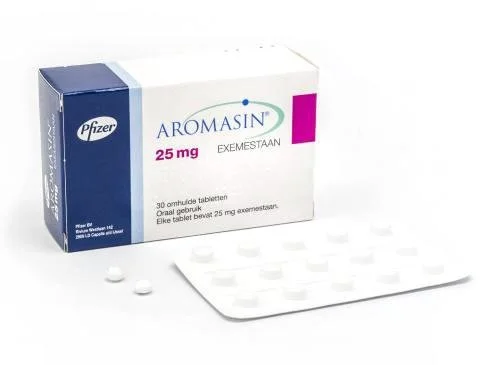
Aromasin Exemestane Pfizer
Exemestane is a synthetic androgen analogue. It is a steroidal aromatase inhibitor that binds irreversibly to and inhibits the aromatase enzyme, thereby blocking the conversion of cholesterol to pregnenolone and the peripheral aromatization of androgenic precursors into estrogens. Exemestane has been associated with a low rate of serum enzyme elevations during therapy and rare cases of clinically apparent liver injury. This medication is used to treat certain types of breast cancer (such as hormone receptor-positive breast cancer) in postmenopausal women. Exemestane is also used to help prevent cancer from returning. Some types of breast cancer grow faster because of a natural hormone called estrogen. Exemestane decreases the amount of estrogen the body produces and helps slow or reverse the growth of these breast cancers. Exemestane is generally not used in women of childbearing age. Exemestane is usually taken once daily after a meal. Take Exemestane at about the same time every day. You may need to take Exemestane for several years or more. Continue taking Exemestane even if you feel well. Do not stop taking Exemestane without talking to your doctor. Effect on estrogens Suppression of plasma estrogen (estradiol, estrone and estrone sulfate) is observed from a daily dose of 5 mg of exemestane, with a maximum suppression of at least 85% to 95% achieved with a dose of 25 mg. Exemestane 25 mg per day reduces whole-body aromatization (measured by injection of radiolabeled androstenedione) by 98% in postmenopausal women with breast cancer. After a single dose of Exemestane 25 mg, maximum suppression of circulating estrogens occurs 2 to 3 days after administration and persists for 4 to 5 days. Effect on corticosteroids: In multiple-dose trials up to 200 mg per day, the selectivity of exemestane was evaluated by examining its effect on adrenal steroids. Exemestane did not affect cortisol or aldosterone secretion at baseline or in response to ACTH at any dose. Thus, no glucocorticoid or mineralocorticoid replacement therapy is necessary with exemestane treatment. Other endocrine effects: Exemestane does not bind significantly to steroid receptors, except for a slight affinity for the androgen receptor (0.28% relative to dihydrotestosterone). The binding affinity of its 17-dihydrometabolite to the androgen receptor, however, is 100 times greater than that of the parent compound. Daily doses of exemestane up to 25 mg had no significant effect on circulating levels of androstenedione, dehydroepiandrosterone sulfate, or 17-hydroxyprogesterone and were associated with small decreases in circulating testosterone levels. Increases in testosterone and androstenedione levels were observed at daily doses of 200 mg or more.A dose-dependent decrease in sex hormone-binding globulin (SHBG) was observed with daily doses of exemestane of 2.5 mg or higher. Slight, dose-independent increases in serum levels of luteinizing hormone (LH) and follicle-stimulating hormone (FSH) were observed, even at low doses, as a consequence of feedback at the pituitary level. Exemestane 25 mg daily had no significant effect on thyroid function [free triiodothyronine (FT3), free thyroxine (FT4), and thyroid-stimulating hormone (TSH)]. Absorption: Exemestane is widely distributed in tissues. Exemestane is 90% bound to plasma proteins, and the bound fraction is independent of the total concentration. Albumin and α11-acid glycoprotein contribute to binding. The distribution of exemestane and its metabolites in blood cells is negligible. Metabolism: Exemestane is extensively metabolized. The initial steps in exemestane metabolism are the oxidation of the methylene group at position 6 and the reduction of the 17-keto group with subsequent formation of many secondary metabolites. Each metabolite represents only a limited amount of drug-related material. The metabolites are inactive or inhibit aromatase with decreased potency compared to the parent drug. A metabolite may have androgenic activity [see Pharmacodynamics]. Studies using human liver preparations indicate that cytochrome P450 3A4 (CYP 3A4) is the principal isoenzyme involved in the oxidation of exemestane. Exemestane is also metabolized by aldoketo reductases.Studies using human liver preparations indicate that cytochrome P450 3A4 (CYP 3A4) is the main isoenzyme involved in the oxidation of exemestane. Exemestane is also metabolized by aldoketorreductases.Studies using human liver preparations indicate that cytochrome P450 3A4 (CYP 3A4) is the main isoenzyme involved in the oxidation of exemestane. Exemestane is also metabolized by aldoketorreductases.
Exemestane is a synthetic androgen analogue. It is a steroidal aromatase inhibitor that binds irreversibly to and inhibits the aromatase enzyme, thereby blocking the conversion of cholesterol to pregnenolone and the peripheral aromatization of androgenic precursors into estrogens. Exemestane has been associated with a low rate of serum enzyme elevations during therapy and rare cases of clinically apparent liver injury. This medication is used to treat certain types of breast cancer (such as hormone receptor-positive breast cancer) in postmenopausal women. Exemestane is also used to help prevent cancer from returning. Some types of breast cancer grow faster because of a natural hormone called estrogen. Exemestane decreases the amount of estrogen the body produces and helps slow or reverse the growth of these breast cancers. Exemestane is generally not used in women of childbearing age. Exemestane is usually taken once daily after a meal. Take Exemestane at about the same time every day. You may need to take Exemestane for several years or more. Continue taking Exemestane even if you feel well. Do not stop taking Exemestane without talking to your doctor. Effect on estrogens Suppression of plasma estrogen (estradiol, estrone and estrone sulfate) is observed from a daily dose of 5 mg of exemestane, with a maximum suppression of at least 85% to 95% achieved with a dose of 25 mg. Exemestane 25 mg per day reduces whole-body aromatization (measured by injection of radiolabeled androstenedione) by 98% in postmenopausal women with breast cancer. After a single dose of Exemestane 25 mg, maximum suppression of circulating estrogens occurs 2 to 3 days after administration and persists for 4 to 5 days. Effect on corticosteroids: In multiple-dose trials up to 200 mg per day, the selectivity of exemestane was evaluated by examining its effect on adrenal steroids. Exemestane did not affect cortisol or aldosterone secretion at baseline or in response to ACTH at any dose. Thus, no glucocorticoid or mineralocorticoid replacement therapy is necessary with exemestane treatment. Other endocrine effects: Exemestane does not bind significantly to steroid receptors, except for a slight affinity for the androgen receptor (0.28% relative to dihydrotestosterone). The binding affinity of its 17-dihydrometabolite to the androgen receptor, however, is 100 times greater than that of the parent compound. Daily doses of exemestane up to 25 mg had no significant effect on circulating levels of androstenedione, dehydroepiandrosterone sulfate, or 17-hydroxyprogesterone and were associated with small decreases in circulating testosterone levels. Increases in testosterone and androstenedione levels were observed at daily doses of 200 mg or more.A dose-dependent decrease in sex hormone-binding globulin (SHBG) was observed with daily doses of exemestane of 2.5 mg or higher. Slight, dose-independent increases in serum levels of luteinizing hormone (LH) and follicle-stimulating hormone (FSH) were observed, even at low doses, as a consequence of feedback at the pituitary level. Exemestane 25 mg daily had no significant effect on thyroid function [free triiodothyronine (FT3), free thyroxine (FT4), and thyroid-stimulating hormone (TSH)]. Absorption: Exemestane is widely distributed in tissues. Exemestane is 90% bound to plasma proteins, and the bound fraction is independent of the total concentration. Albumin and α11-acid glycoprotein contribute to binding. The distribution of exemestane and its metabolites in blood cells is negligible. Metabolism: Exemestane is extensively metabolized. The initial steps in exemestane metabolism are the oxidation of the methylene group at position 6 and the reduction of the 17-keto group with subsequent formation of many secondary metabolites. Each metabolite represents only a limited amount of drug-related material. The metabolites are inactive or inhibit aromatase with decreased potency compared to the parent drug. A metabolite may have androgenic activity [see Pharmacodynamics]. Studies using human liver preparations indicate that cytochrome P450 3A4 (CYP 3A4) is the principal isoenzyme involved in the oxidation of exemestane. Exemestane is also metabolized by aldoketo reductases.Studies using human liver preparations indicate that cytochrome P450 3A4 (CYP 3A4) is the main isoenzyme involved in the oxidation of exemestane. Exemestane is also metabolized by aldoketorreductases.Studies using human liver preparations indicate that cytochrome P450 3A4 (CYP 3A4) is the main isoenzyme involved in the oxidation of exemestane. Exemestane is also metabolized by aldoketorreductases.